|
India wants to sign the nuke deal with the U.S. but plans to buy reactors from Russia & France if and when the NSG approves the proposal.
After the disgusting drama in the Indian Parliament last week, during the Indo-U.S. nuke deal debate, people ask if INDIA is a democracy or a DemoNocracy?
Washington D.C. Wednesday July 30, 2008: The whole disgusting bribery drama surrounding the sham confidence vote (on the Indo-US nuke deal) in the British-built Lok Sabha (Parliament) building, in New Delhi last week, has made a young correspondent of the HINDU newspaper wonder whether INDIA is a democracy or a DemoNocracy?
( http://www.thehindu.com/2008/07/28/stories/2008072858120300.htm )
An excellent news analysis, by widely-read V.R. Krishna Iyer, in the same prestigious newspaper (Chennaibased HINDU), on the same day (July 28, 2008), provides an apt answer to the question posed by the young correspondent, quoted above, who had written that, “from the beginning of our civic education we have been told that our Parliament is a Temple Of Democracy. It is frightening to think we have elected such a breed of people to be our representatives who can sink to such levels for their vested interests.” In the News Analysis headlined, ‘Democracy drugged, debauched and depraved,’ V.R. Krishna Iyer wrote in the HINDU of July 28, that, ( http://www.thehindu.com/2008/07/28/stories/2008072850481100.htm ) “Members of Parliament, a pro-tem Prime Minister, some power-hungry parties and certain sinister political power-brokers blasphemed India before the world during the recent session of the Lok Sabha. They demoralized Indian humanity, which puts its sacred trust in swaraj and the Constitution. The people’s confidence in parliamentary institutions and the Cabinet system was shaken and scandalized. Whoever might have won the confidence motion in numerical terms, the country lost its confidence in the travesty that passed for democracy. The special session proved, thanks to the manner of operation of the parties and the politicians, Dr. Samuel Johnson’s definition that, ‘Patriotism is the last refuge of a scoundrel’. Going by the betrayals and great abstentions seen during the voting process, our integrity seems to have gone haywire and taken a holiday. Even the respected and impartial Speaker has come under controversy.”
Krishna Iyer’s excellent news analysis, in the HINDU, goes on to say that, “The pro-Bush Prime Minister, known for his probity, verity, decency, dignity and simplicity, faces pungent political polemics… A verdict by Parliament on a crucial motion of political paramountcy commands moral authority when the majority vote truly represents every member’s judgment on the proposition at issue. But if the process suffers deception and other fundamental flaws, Parliament is sick and its verdict is weak, though legally the Speaker pronounces who has won the vote and that holds good.” Dr. Manmohan Singh claims to have secured a victory in his confidence motion after the debate. The glory of the parliamentary system lies in the free, frank, fearless, lucid, lucent expression of views by members without affection or ill-will, but true to one’s conviction and conscience, and any party mandate. If money corrupts, if pressure and threat tamper, if temptation for office or other extraneous considerations vitiate, if voices are muffled by noises, if members behave in berserk fashion and the House degenerates into bedlam, if sanity is silenced by sound and fury, if acrobatics, theatricality and looney display of crores of rupees worth of currency notes pollutes the sanctity of the solemn Lok Sabha, the efforts of the Speaker, great though he be, will be in vain as he tries to regulate order but fails to restore peace and check the chaos. In such cases the morality of the verdict becomes dubious… Here in India our Prime Minister was not allowed to speak by the use of noise terrorism — which was a pathetic and bathetic barbarity. The speeches of many members who spoke during the session were inaudible. Even the Leader of the House, the wonder whose speech the House and the country waited to hear, could not perform because of the stridency of the Opposition benches. The Prime Minister handed over his manuscript eloquence to the Speaker, denying the country the right to hear him. Was that a debate, just a presentation and a noetic submission? Or was it a situation where intelligent expression and sound argument became the casualties? Yet, the Speaker, with rare dexterity and deft management skills, got through the allotted hours. The counting of votes followed, the anarchy subsided, and the Chair pronounced that the motion was carried.” India some democracy nay some ‘DemoNocracy’!
The prestigious Economist, London, in a report, headlined, ‘Indian politics A tarnished triumph,’ used polite diplomatic language, to say about the same thing as V.R. Krishna Iyer (who has been quoted above) when the British magazine wrote, on July 24, that, “The (Indian) government wins a hard-fought victory over its cherished nuclear deal with America. Its image and credibility have paid a high price. AFTER a rancorous, sometimes riotous, two-day debate on its most contentious policy, a nuclear co-operation agreement with America, India’s government on July 22nd won a parliamentary vote of confidence. This did not ensure the survival of the vexed agreement, on which George Bush and India’s prime minister, Manmohan Singh, shook hands in July 2005. It still needs the approval of several bodies, including the UN’s International Atomic Energy Agency (IAEA). But the government’s victory, by 275 votes to 256, with ten abstentions, has probably saved it from strangulation by its Indian opponents. It has also prolonged the government, at least for a bit.”
In a related article a journalist, G.S. Bhargava, writing in yesterday’s (July 29th) Chandigrah-based Tribune, under the headline, ‘Was it all worth it,’ wrote that, “Above all, according to the present indications, the Government will be wallowing in the nuclear ‘Deal’ for some time, until the US Congress takes it up… The near unanimous judgment of public opinion, as reflected by the print and electronic media which highlighted the bizarre happenings in the Lok Sabha on July 22 (during voting on the confidence motion) was, that it was a disgrace to India’s democratic polity - more important than the moral aspect is the material cost. Hence the throw back in time to the first century BC when King Pyrrhus of the Greek kingdom of Epirus defeated the Romans, at great cost, in wars waged in two successive years – 280 and 279 BC – and rued, “ one more such victory and I am lost.” ( http://www.tribuneindia.com/2008/20080729/edit.htm#6 )
As for the other costs of winning the confidence vote, Bhargava wrote that, “the chickens still have to come home to roost, even if the contours of the prospective scenario are visible to the naked eye. First and foremost, the Prime Minister will have to kiss goodbye the long dangled idea of reservation of seats in legislatures for women, even if his Government lasts the full term until May-end 2009.”
The next three steps in the India-US ‘Nukes-for–mangoes’ deal now would be to seek the approval of the draft of the India-specific safeguards agreement jointly prepared by officials of the government of India and the Vienna-based International Atomic Energy Agency (IAEA) by the Board of Governors of the IAEA before it is formally signed by India and the IAEA. (For a backgrounder read Khalistan Calling dated May 16, 2007 headlined, “Musings on the Indo-U.S. ‘Nukes-for-Mangoes’ Deal” by clicking at:
http://www.khalistan-affairs.org/home/khalistancalling/2007/may16.aspx )
Once the India-specific safeguards agreement is signed by the IAEA, then the proposal will be sent for a consensus to the 45 members Nuclear Suppliers’ Group (NSG) on the removal of the restrictions on nuclear trade with India. The 45member NSG is made up of the following countries:-Argentina, Australia, Austria, Belarus, Belgium, Brazil, Bulgaria, Canada, China, Croatia, Cyprus, Czech Republic, Denmark, Estonia, Finland, France, Germany, Greece, Hungary, Ireland, Italy, Japan, Kazakhstan, Latvia, Lithuania, Luxembourg, Malta, Netherlands, New Zealand, Norway, Poland, Portugal, Romania, Russia, Slovakia, Slovenia, South Africa, South Korea, Spain, Sweden, Switzerland, Turkey, Ukraine, United Kingdom, and United States. Once the NSG approves the proposal (a unanimous consensus of ALL its 43 members is required) the ‘Indo-US Nukes-for Mangoes’ deal will then go to the U.S. Congress for approval.
It will be worth remembering that during the internal negotiation process in Washington over the wording of the Hyde Act, the State Department’s principal nuclear negotiator, Richard Stratford, had argued that Congress was getting the sequencing wrong in vetting the 123 Agreement after the NSG had already acted. By insisting that the NSG act first, he said, India would be free to access nuclear supplies from elsewhere even if the U.S. Congress were to shoot down or delay ratification of the 123 Agreement. This is exactly what India, France and Russia have in mind. Partly in order to deal with this problem, the U.S. now believes it has secured a ‘political understanding’ from Russia and France that they would not rush to conclude export deals with India as soon as the NSG waiver comes through and would wait till the U.S. Congress has the chance to ratify the 123 Agreement. Some hope!
Interestingly, yesterday’s (July 29, 2008) issue of the HINDU newspaper carries
( http://www.thehindu.com/2008/07/29/stories/2008072955290100.htm )
a Front Page New Delhi-datelined report, by one Siddharth Varadarajan, headlined, ‘No ‘unconditional’ NSG nod for India, says U.S.’ The above HINDU report says that, “Though India has made it clear that it expects the United States to deliver a ‘clean and unconditional exemption’ for it from the export guidelines of the Nuclear Suppliers Group, Washington says it is committed only to a ‘clean’ and not ‘unconditional’ waiver for New Delhi. The distinction has not been lost on Indian officials as they await the American draft changes to the NSG guidelines. According to sources, the draft is still going through the ‘inter-agency process’ in Washington and might be handed over to New Delhi by Tuesday.
Meanwhile, U.S. Ambassador to India David C. Mulford, at a press conference on July 23, was at pains, (according to the above HINDU front page report) to clarify to journalists the distinction between the two concepts. The U.S. Ambassador said the, “review by Congress would be one of the ‘pieces’ that NSG members would consider in granting their waiver, thereby opening the possibility of America seeking to tie the cartel down to not moving ahead with India until the domestic legislative process in the U.S. is complete.”
While the decisions of the IAEA and the NSG would determine the conditions under which the member-countries of the IAEA and the NSG would trade with India in civilian nuclear matters, the US Congress would decide the conditions under which the US would trade with India in the nuclear field. The IAEA is expected to take a decision by the end of August and the NSG in the beginning of September if the US has its way. It has been reported that Pakistan, which is a member of the Board of Governors of the IAEA, has already submitted a long memorandum to the IAEA raising objections to the proposed safeguards agreement on procedural ground, on grounds of merit and on the ground that it would amount to unfair discrimination to Pakistan. The procedural objection is that the required minimum notice has not been given to the member-countries of the Board of Governors of the IAEA to consider the agreement carefully and that an attempt is being made to rush through the approval process. The objection on merit relates to alleged dangers of diversion of uranium purchased by India from overseas suppliers for weapons purposes thereby adding to the threat to Pakistan. Incidentally, Pakistan which is not a member of the NSG would, therefore, have to depend on China (and/or Turkey), according to Indian press reports, for taking up the issue of alleged unfair discrimination to Pakistan. These planted reports in the Indian media also suggest that in the NSG China would strongly underline the need to remove the restrictions on nuclear trade with Pakistan without linking it to the lifting of the restrictions on nuclear trade with India.
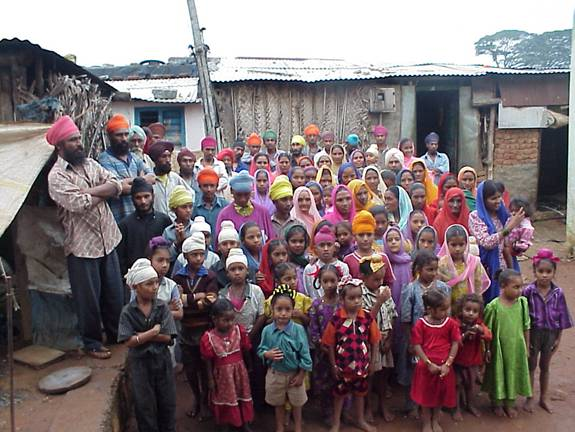
The three million strong Sikh diaspora (which includes half a million Sikh-Americans in the United States) continue to watch and listen hoping that, the US-India ‘Nukes-for-Mangoes’ deal fails to get a clearance from the Nuclear Suppliers Group and the IAEA. They all hope the nukes just go away! The 3 million strong diaspora Sikhs fear for the safety and future of the 22 million Sikhs living dangerously and unhappily (as second class citizens) in their South Asian homeland of Punjab, Khalistan, under brutal Indian occupation, which is sandwiched between two nuclear armed South Asian rivals, India and Pakistan. As a result the Sikhs have been demanding, and will continue demanding and working for a nuclear/missile free South Asia as it is a question of survival of the Sikh people and their historic holy shrines located in both India and Pakistan.
( http://khalistan-affairs.org/home/khalistancalling/2006/december06.aspx )
The Sikhs want a South Asia free of missiles and Nuclear weapons and nuclear tests – they want peace in order to survive. That is why the Washington-based Khalistan Affairs Center made a heroic effort in November/December last year to lobby against the U.S.-India ‘Nukes-for-Mangoes’ deal as the half million strong Sikh-American community senses grave dangers in the current situation, where India and Pakistan, have nuclear missiles pointed at each other with the Sikh Homeland of Punjab, Khalistan, (with its 22 million Sikhs and numerous holy shrines) sandwiched as it is, between the two as a convenient battleground for both conventional and non-conventional warfare.
|